Caviar Diplomacy
Notes on an All-Expenses-Paid Tour of an Ethnic Cleansing

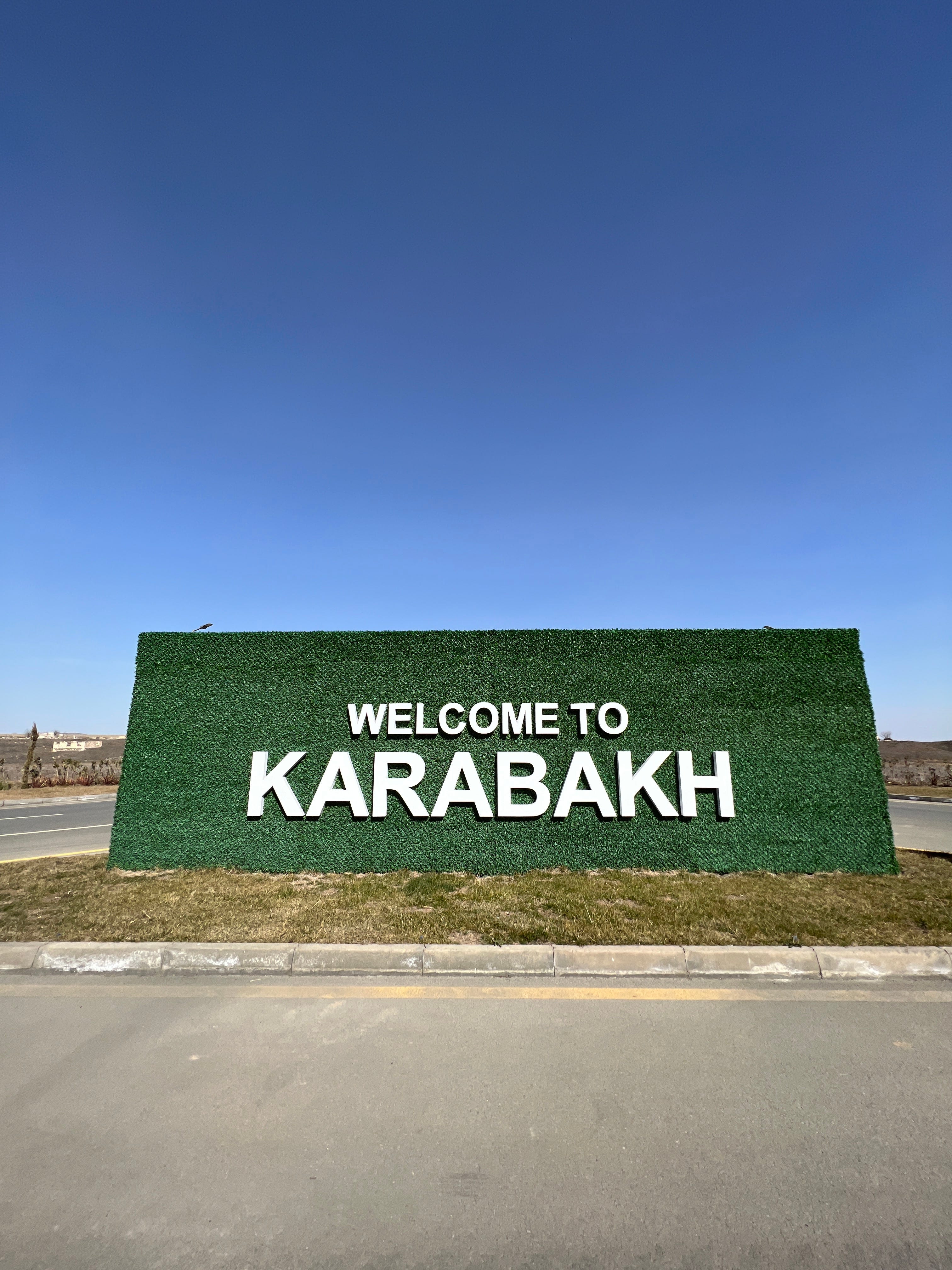
There are no questions asked when we arrive at the first checkpoint.
Through the driver’s side window, soldiers glare at me sitting nervously in the passenger seat. One glances at our passports, then waves us through. Several more checkpoints come and go as Adnan and I drive through a mountainous valley, picturesque and silent. An hour passes and ours is still the only car without a military insignia or red cross.
“Those are Russians,” Adnan says as we stop before a thin picket line featuring more soldiers than picketers. The Russian tricolour flies from a flagpole above the scene.
As soon as we step out of the vehicle, the chanting begins. “Stop, stop, ecocide! Stop, stop, ecocide!”
Two days earlier, I had arrived in Baku, the capital of Azerbaijan. While waiting at the departure gate in a Georgian airport, I took an unexpected call from Nika, a director at the Network of Azerbaijani Canadians. “I heard there’s a blockade,” I stuttered into the phone, still nursing a hangover from an all-nighter at Bassiani that had lasted well into the afternoon. The kind of night that leaves your judgment soft.
Nika had gotten my number from Adam, a friend and journalist who had taken part in a group tour of Azerbaijan the year prior. I was fresh off my own press tour of wartime Ukraine and figured I’d take the opportunity to write an article or two about Azerbaijan’s blockade of Nagorno-Karabakh—an Armenian-populated ethnic enclave and separatist zone within Azeri territory.
“The term ‘blockade’ is problematic,” she said. “There’s more to it than that. There were 700,000 Azeris killed or ethnically cleansed from Karabakh. I can connect you with an activist in Baku who can show you the area.”
Jackpot, baby.
How I Got There
In mid-February 2023, I had just finished a month-long stint in Armenia. By that point in my travels, I’d been on the road for over two and a half years—drifting east from Canada through Europe, the Middle East, and the Caucasus, stringing together freelance articles and a marketing day job whose demands I had whittled down to about two hours of work per night. ChatGPT had just launched, and my colleagues were pushing me to produce AI slop at an industrial scale. My productivity was nosediving. I was leaning full-on into the journalism and media stuff, and couldn’t care less about gold and crypto and all the bullshit I was being paid to believe in. I suspected I’d be fired within weeks. It would take them another year, in Colombia, to finally pull the plug. It was a miracle I lasted that long. It’s still a miracle.
In Yerevan, I’d been exposed to the Armenian perspective on the Karabakh conflict, which was largely one of general fatigue, if not outright resignation. Most citizens of the Armenian capital didn’t seem to feel strongly about it. But I had spent a long weekend with a local fixer on the Karabakh border in the southern border town of Goris, where I produced a short YouTube vlogumentary centering the perspectives of displaced Armenians who had lived in Artsakh (the Armenian term for their ethnic enclave in Azerbaijan) until the blockade forced them out. They were almost universally alienated from their loved ones still stuck on the other side. These displaced Armenians lived in hotels, where I interviewed them. Many had deep traumas to vent about their persecution and the pogroms suffered at the hands of Azeris.
A friend and colleague, Fin DePencier, had called me while I was still in Armenia to give me a full briefing on the blockade situation in Karabakh, and that’s when I decided I had to go. In Yerevan, I’d also met with the Canadian and fiercely pro-Armenia reporter Neil Hauer, who further inspired me over beers in a bohemian bar full of the young and free Armenians I had come to know and love. Between Fin, Neil, and Adam—three people I respected—I felt like the story was calling me, almost writing itself.
I ventured to Azerbaijan largely ignorant but open to the “other side.” I had called myself a journalist. Nika, Adam—they all believed it. But what I was, I didn’t really know. I was a guy with a phone, a GoPro, and a carry-on backpack that fit under my seat.
Baku
On February 19, I flew into Baku from Tbilisi, Georgia. Land borders are closed, so an overpriced fifty-minute flight is the only way in. My initial flights came to $315.63 CAD round trip—a bit steep for two regional hops with just a carry-on bag. I travelled that entire year circumnavigating the globe east to west, flying transatlantic on New Year’s Eve from Toronto to Europe, then on to North Africa, the Middle East, Central, South, and East Asia before flying over the Pacific from Tokyo back to Toronto for Christmas—all without any luggage. I had perfected the art of dirtbagging.
When I landed at Heydar Aliyev International Airport, I received another phone call from Nika. It was a pleasant thirty-minute conversation while I anxiously paced around the arrivals section. The first red flag was when she pushed back on my question about the ongoing blockade of the Lachin Corridor—the only road in or out of the Armenian-populated area of Nagorno-Karabakh. She insisted there was more to the story: that Artsakhians could freely exit and enter, that other powers were at play, and that the international community was just politically pressured into opposing Azerbaijan. She said she would forward my contact to activists in Baku who could give me a tour of the Lachin “blockade” so I could see for myself.


Outside the airport, I was swarmed by local taxi drivers in an unprecedentedly aggressive bidding process. I caught one into the city for about $10 CAD and checked into SAHIL Hostel downtown. I paid 50 AZN—about $40 CAD—for five nights in a spotless, modern, and almost empty dorm with luxurious amenities: a grand balcony, lounge room, office space, and a workout nook, right in the heart of historic Baku. For <$9 per night, you can’t do better.


The first days in Baku were relaxed. I toured the city by day, went for runs along the Caspian Sea boardwalk at sunset, and worked my remote marketing day job at night for a few hours until I could pass out and set my Slack to DND. The “Paris of the East” was largely that—spectacular and opulent and slick with oil money. The historic quarters are well-preserved and contrasted by postmodern skyscrapers looming in the background. Humongous flags and propaganda posters are plastered on seemingly every corner. Something that, even for a nationalist, made me deeply unsettled.
There’s a decent number of tourists in Baku. I never really felt like all eyes were on me, nor did anyone act surprised by seeing a roaming white boy. They probably assumed I was Russian, which is nothing out of the ordinary.


In fact, I would often eat at restaurants with uniformed Russian soldiers gathered around neighbouring tables. These always felt like weird hallucinations, since I was fresh out of the Donbas and Kharkiv oblasts of Ukraine, where for months the elusive “Russian soldier” was the invisible threat to my life, always lurking somewhere beyond the sound of artillery or gunfire. But here they were, right beside me, gorging on the same bowl of rice and lamb as I, scrolling the same apps as I, huffing off the same stupid vapes as I. Both resigned to the same infinite scroll.
Azerbaijan is allied with Israel, as well as Ukraine and the West, generally speaking. On the few occasions I broached politics with random Azeris, they all seemed to want me to feel as if I were in an allied country. But their true allegiance is pan-Turkic, with deep ties to their historical motherland in Ankara. The Azeri people also share deep cultural and ethnic ties stretching into northern Iran.
It’s also worth noting that physical culture is taken very seriously in Azerbaijan, with a strong Soviet weightlifting and strongman tradition. At a local Baku gym, I loaded four plates on the deadlift bar and repped it out—I got maybe seven or eight. While I was lifting, a group of young Azeri men encircled me and cheered me on. I’ve never experienced that sense of gymbro camaraderie in any country elsewhere.
The gyms themselves were spotless and ornate and often very expensive-looking, if not outright gaudy. I remember one had a huge statue of Arnold Schwarzenegger at the centre of a domed pantheon of Mr. Olympia winners pictured around it, in order.
My second red flag came at the hands of a local döner kebab vendor, who charged me $8.50 CAD for a simple pita. I asked him repeatedly if he got the price right and he assured me yes, before I tapped my card. When I asked the concierge at my hostel if I had been scammed, he confirmed I was certainly charged double. To test this, I went back the following day, asked for the same kebab, and they again quoted me $8.50. This time I just walked away. Azerbaijan is the first and only country out of sixty-plus where the kebab guy got me.
If you need anything quick in Baku, you just need to pop your head into any of the countless kiosks on the street. These kiosks are cramped and tiny but contain just about anything you need, including loose, individual Western cigarettes sold for pennies each. They even have a lighter dangling from a string by the checkout so you can light up right there on the spot.


Over the years, I’ve developed a litmus test for determining whether a country is good or not. Whenever you see a poster or billboard of an important-looking politican, point to it and ask someone: “Who is this guy?” Those exact words.
If you’re someplace cool, you’ll get a short rant or a dismissive or critical remark. If you’re someplace whack, you’ll be admonished for belittling the dear leader as a mere “guy”—“Don’t you know that’s the President?” they’ll sneer, before explaining what a perfect man he is. The worst country for this was Tajikistan, where President Emomali Rahmon, currently in the 33rd year of his first term, is revered even by the few progressive Millennials I chummed up with. Any attempt at light criticism was met with snide rebuke.
Same deal here. The ruling Aliyev family’s patriarchs are plastered everywhere, and their names are adorned on public schools and streets. President Ilham Aliyev—who assumed power from his father in 2003 and has held it since by way of elections that Freedom House calls “not free”—presides over one of the most repressive media environments in the world. Azerbaijan ranks 167th out of 180 countries on the Reporters Without Borders press freedom index. Journalists who criticize the regime are routinely jailed. The Freedom in the World ranking places Azerbaijan 10th-worst globally—behind even Taliban-ruled Afghanistan. Despite this, locals assured me that Azeris are free to criticize whoever they please.
Adnan
Eventually, I got a text from the “activist on the ground”: Adnan Hussein, a thirty-something who introduced himself as a local activist and real estate agent. I met him at an extremely ornate café in central Baku. The place appeared as if made top to bottom in granite, and the waiters wore tuxedos with a hand towel draped over their forearms.
Adnan seemed like a kind family man. He spoke perfect English. We talked for hours. Although the Ministry of Foreign Affairs in Baku had ignored my application for press accreditation—by contrast, Armenia issued me a press card with almost no questions asked—Adnan took serious interest in my journalism. I slid him my phone across the table, with my articles from wartime Ukraine loaded on the screen. He read carefully, in silence, for a good ten or twenty minutes. When he gave me back the phone, he said he liked what I wrote and wanted to take me to Karabakh right away.
He framed it as a simple road trip. It was just a few hours away, he said, and he could pick me up from my hostel the following morning at 8 a.m. sharp. He covered the bill. I went home to, once again, pack my bags and go.
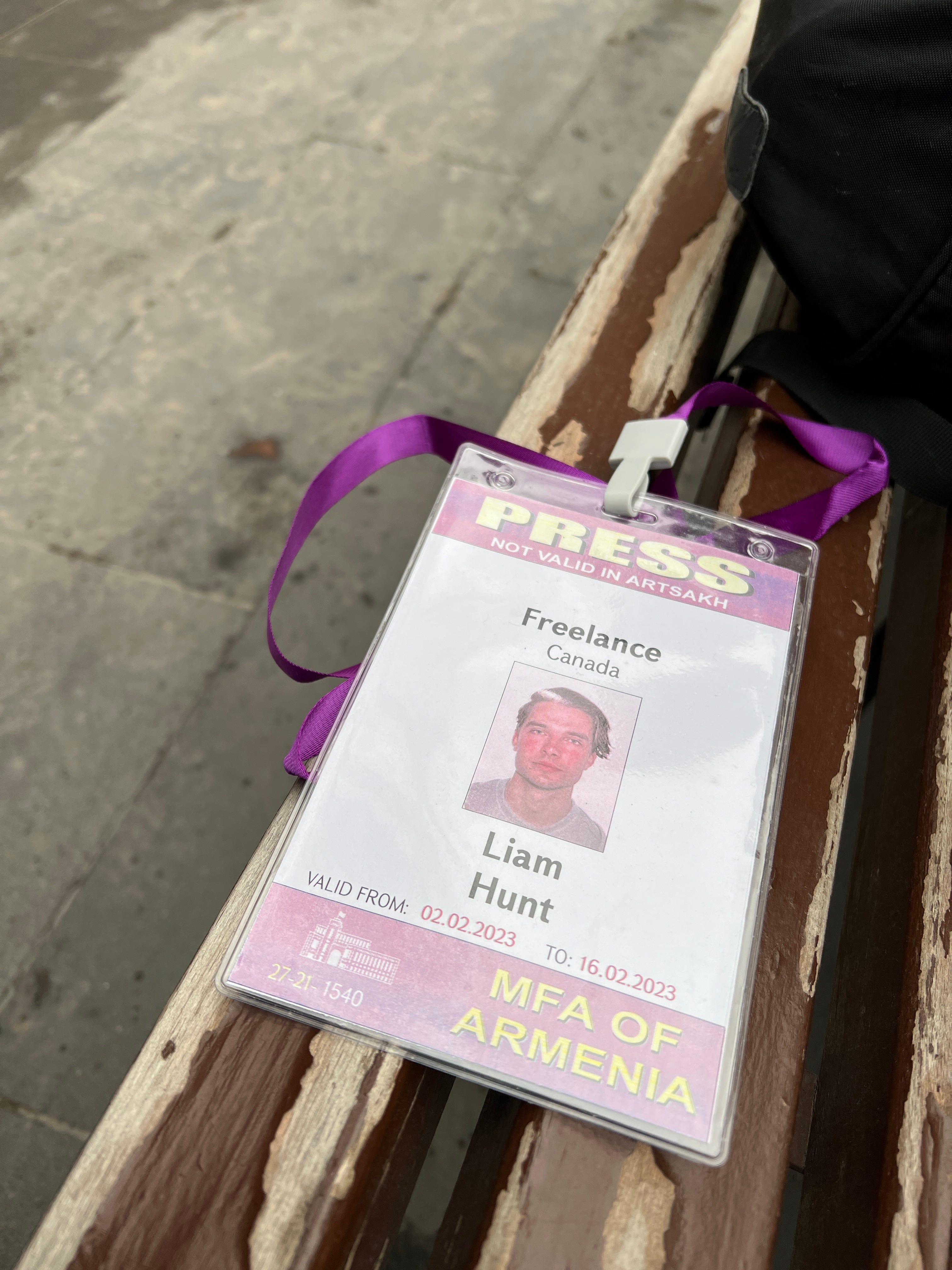
There’s only one road connecting the Armenian population in Karabakh to Armenia proper, he told me. “It’s called the Lachin Corridor. For eight weeks, our environmental activists have been protesting on the road. I’ve spent most weekends picketing there since the protests started.” He assured me that the protests didn’t constitute a blockade. “You’ll see it yourself—we’ll go tomorrow. Anyone can pass through. There is no blockade.”
The Drive
The next day, Adnan picked me up and we drove.
In the morning, it was so-far-so-good. We stopped at a roadside diner to eat—his treat—which was decorated with Turkish and Azeri flags and propaganda posters of the Aliyev family with bold, block-letter text declaring Karabakh theirs. Indeed, much of it was: the 2020 war had returned all but the city of Stepanakert to Azerbaijan, due in large part to the country’s overwhelming economic superiority as an energy exporter and its use of drone warfare on a scale the world hadn’t seen before. The retaking of the historic city of Shusha in November 2020, after a fierce three-day battle through mountainous terrain, was celebrated as Azerbaijan’s crowning military achievement and a victory that brought millions of Azeris to tears and effectively ended the decades-long war.


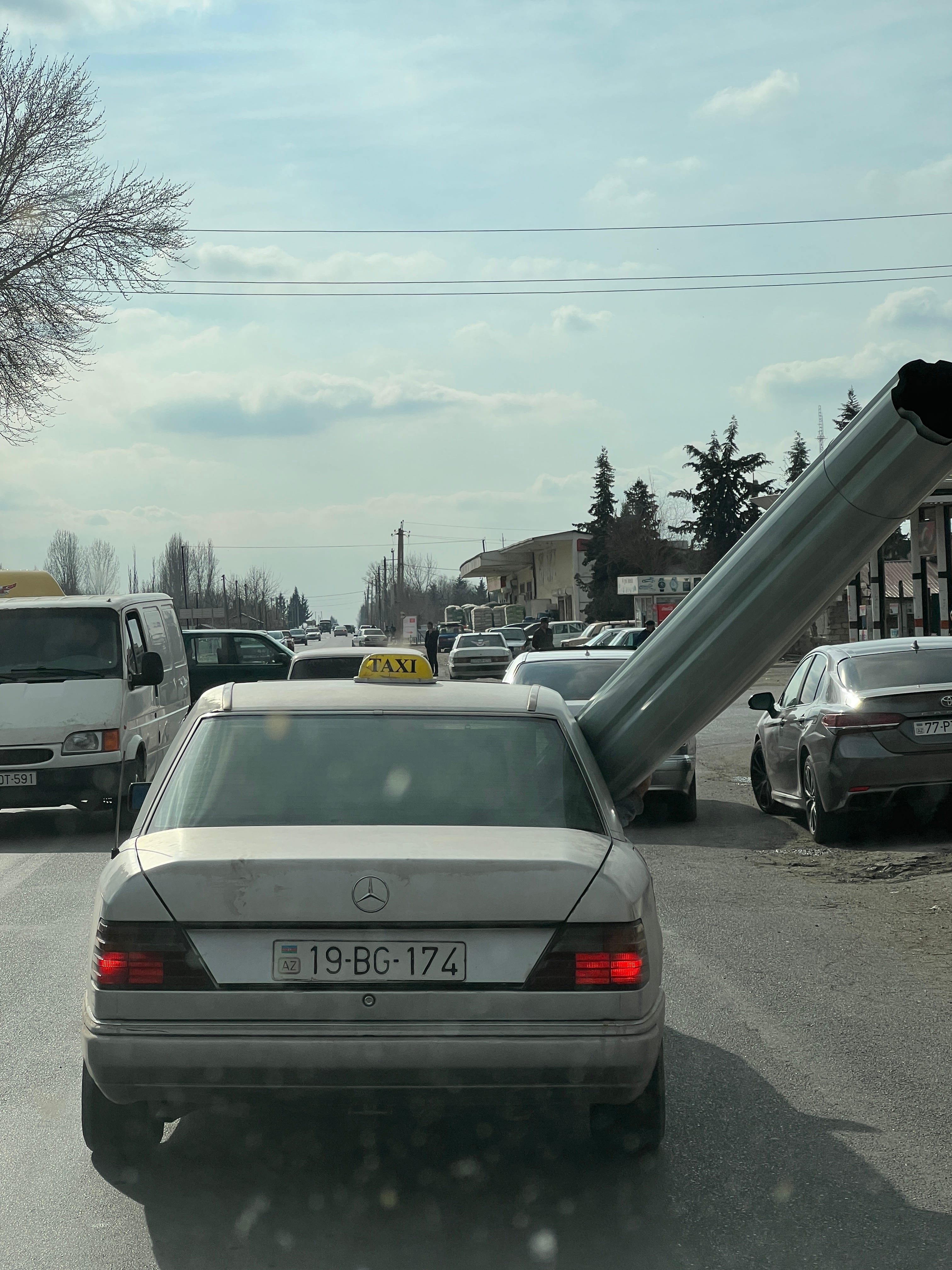
Adnan pointed out the Iranian border on the left side of the road as we drove, just a stone’s throw from our SUV. On the right side, small Azeri villages slipped by, where it became obvious that the nation’s obscene oil fortune hardly extended beyond the borders of Baku. It looked like any Georgian or Armenian or even Central Asian village, with dilapidated homes, old Soviet cars, cracked single-lane roads, donkeys, horses, and random displays of backwater culture, such as—I kid you not—a fifteen-foot iron pipe sticking out of the passenger window of a taxi. No flag on it either. But if there was, I have a feeling what it’d look like.
As the day grew on and we arrived closer to Lachin, the first hints that I had been deceived began to materialize. We started making impromptu stops on the side of the highway, where Adnan and I would get out of the car and walk around a ghost town or a cemetery or a destroyed mosque—all remnants of the First Nagorno-Karabakh War in the early 1990s. Adnan emphasized repeatedly that all of these sites—once the sacred and ancestral home to Armenians and Azeris alike—were left undeveloped and unprotected while occupied by the Armenians, who had won the first war. Since the Azeris retook the land in late 2020, Azerbaijan had already taken impressive measures to restore, redevelop, and repopulate these areas. If the Armenian side truly believed they were the rightful inheritors of these ancestral lands, whose border had been arbitrarily drawn up by Bolshevik authorities a century ago, then why didn’t they make any effort to develop them and make them hospitable again? Instead, they let them rot in ruins. This was Adnan’s message, repeated ad nauseam.
His argument was compelling on its surface.
Then they started appearing. One by one, more of Adnan’s “friends” magically appeared at various roadside stops. Adnan would sporadically pull over and inform me that a friend of his happened to be in the area and would be happy to give me a quick tour of such-and-such can’t-miss site. He encouraged me to film and record everything freely. These men would sometimes introduce themselves as government personnel, other times not. But we would quickly meet, shake hands, and they would deliver a ten-minute speech about whatever historically significant thing stood before us—usually the site of a battle or a historic Azeri community driven out by Armenians during the first war. Then Adnan would usher me back to the car and we’d carry on.
This is when I got the first inkling that I had been roped into a full-blown Potemkin tour. But I was too far gone. We had crossed into militarized Karabakh, and there was no getting back to Baku without Adnan.
Suddenly, a black SUV appeared parked on the opposite side of the highway. If my suspicions hadn’t yet been confirmed, they were at that very moment. When the driver stepped out, I realized exactly what I’d gotten myself into. The man was dressed in a business suit and introduced himself as a Senior Advisor to the President before starting a long and well-rehearsed monologue about the brutality that occurred here in the ’90s and how these lands were triumphantly returned to Azeri control following the country’s historic offensive in October 2020. The wasteland that we looked upon was the living memory of those battles.


Shortly after, Adnan and I ventured into Fuzuli, a larger settlement under extensive reconstruction since Azerbaijan recaptured it. The first stop was the airport, which was pristine and fully operational but without a soul inside. During the airport tour, the vibe turned darkly surreal. What had begun hours ago as an innocuous drive to a protest site had now become a full-fledged and coordinated state propaganda tour.
The Fuzuli airport had just finished construction, with every light burning and every luggage carousel spinning eerily around an empty baggage claim. Not a single employee, security guard, aircraft, nor traveller in sight—just myself, Adnan, and someone from the tourism ministry whose name I never caught. The point of the airport tour was twofold: to demonstrate the technological sophistication of Azeri civil infrastructure, and to show what great care they had taken of the land in the short time since they’d reclaimed it.
“Armenia controlled this land for eighteen years and did nothing with it,” Adnan said as we walked down the barren runway. “If it mattered to them, wouldn’t they have at least tried to do something with it?”
Snow began to fall as we left the airport and continued driving toward the protest zone.


The Lachin Corridor
We arrived at the site of the Lachin blockade—or, as I was emphatically told, the Lachin “protest”—just outside the historic gates of Shusha. Russian military caravans slowly drove down the winding corridor while scores of undergrad-aged Azeris in coordinated, bright-coloured winter clothing stood in formation along the road, chanting and waving manufactured English-language placard signs in unison. Uniformed Russian soldiers stood on guard as peacekeepers. They were the only individuals I was strictly instructed not to photograph while in Azerbaijan.
Immediately, the scene creeped me out. The students, despite chanting and shouting with vigour, were obviously inauthentic. They appeared to me less as an organic protest movement and more like conscripted kids whose university degrees or freedom were contingent on their participation. Later, a few Google searches confirmed that each of these “protesters” were members of Baku-based social organizations with close ties to the Aliyev regime. One prominent group was Bir Könüllü (“One Volunteer”), a student group organized under the Ministry of Science and Education. Another was the RIIB, a direct creation of the Heydar Aliyev Foundation. It would be bafflingly naïve to claim that these protest groups weren’t permitted, organized, and financially backed by the Azeri government.
Ostensibly, the object of the protest was to criticize Armenian mining of the surrounding hills—“ecocide” was their go-to accusation—thus covering up the ethnic cleansing campaign with the veneer of ecological conservation. Despite what the protesters believed—and many seemed to be true believers of this cause—there was little doubt that the genuine motive of the blockade, which had started over two months before I arrived, was to forcibly displace the Armenian population in Stepanakert without having to resort to military force.
I found it strange that the protesters themselves didn’t have an answer for how their demands could be satisfied. When I asked them what a resolution might look like, the terms were “for the government to decide.” They didn’t know the terms they were fighting for, point blank. But most of them did, on the whole, appear to have a legitimate emotional investment in the sanctity of Karabakh. Even if they were shipped in from Baku, they weren’t there under duress. They were there because they saw themselves as protecting their country’s internationally recognized territorial integrity. The fact that the protests are organized top-down, with the state’s hand very clearly all over it, doesn’t discredit the individual protesters’ presence or concerns.


As I walked around the protest site (“Not a blockade! See! The Red Cross is passing through!”), I did something I rarely do—I started tweeting. I posted my live observations and, for the first time, drew significant engagement on Twitter as loyalists on both sides flooded my notifications. My presence at the blockade site was puzzling to most Western onlookers and journalists, since you have to win the trust of the Azeris to be given a military escort to the site. As such, I was the only Western journalist on location during my time in Karabakh.
Within minutes, I started receiving virulent hate mail and harassment from Armenians and Westerners for apparently giving legitimacy to the Azeri perspective. I also received a fair number of disparaging comments from Azeris who disliked my refusal to buy into their ecocide charade and for openly chastising the legitimacy of the so-called protest. My old acquaintance Neil Hauer was particularly scathing in his messages to me, begging me to shut up and get the hell out of there before I became a full-blown mouthpiece for fascists. He still has me blocked to this day.
Within an hour, I watched three International Red Cross SUVs drive through the protest site, carrying Armenians from Stepanakert to Goris, on the Armenian side of the border, where they would forever become refugees locked out of the only home they’d ever known. Adnan and the English-speaking media representatives at the protest considered these IRC transports as proof that the blockade was a Western-Armenian lie.
When I remarked that international human rights organizations were reporting shortages of essential goods in Stepanakert—electricity, fuel, and water—Adnan immediately shot it down. He took out his phone and showed me screenshots of Instagram Stories from Armenian residents in the besieged city, dining out at elegant restaurants and bars. “Does that look like a humanitarian emergency to you?” When I pushed back, citing third-party reports from Human Rights Watch and Amnesty International, he dismissed these organizations as Armenian-bought propagandists.
Curiously, when discussing the 1992 Khojaly massacre committed by Armenians against Azerbaijanis, Adnan happily cited Human Rights Watch as an authoritative source. This quickly became a noticeable pattern of rhetoric: trusting international observers when it favours the Azeri state narrative, but discarding these same sources as biased when it runs counter to it.
Some Azeris were effusive when I approached, often monologuing uninterrupted for a good twenty minutes at a time, as if they’d been waiting their entire lives for a curious stranger with a camera to say, “Here’s your chance, now tell me everything.”
At the protest site, a middle-aged survivor of the Khojaly massacre spoke to my camera, his voice trembling.
“Such a genocide, I would say, never happened in anywhere before,” he said. “They drove tanks to our almost barehanded mothers, sisters, and brothers. They destroyed them in the cold days of winter.” He paused here and there, eyes welling. “I would not wish that tragedy for any nation. How a person can be so cruel. How inhuman you have to be to kill infants with bayonets.” He had lost brothers, relatives, his father’s uncles. “We wish not to have such a day again. We wish peace and wellness.”
For once, I did not hear the words of a propagandist. This was a man who had carried horrors for thirty years, asking some nobody with a GoPro and a backpack to be heard.
The ICJ Order
That night, Adnan and I stayed in a fancy new hotel in Shusha, built swiftly after the 2020 capture of the city to house diplomats and foreigners. All my suspicions of caviar diplomacy were proven true when Adnan informed me that everything was already paid for—my private suite, room service, breakfast, anything I could need. No matter how hard I insisted on paying for reasons of journalistic ethics, Adnan told me all was prepaid and there was nothing I could do. Besides, it would be un-Azeri to have a foreign guest of honour pay.
“Caviar diplomacy” is the term for Azerbaijan’s well-documented strategy of winning the loyalty of foreigners through lavish gifts and luxurious trips. First named in a 2012 report by the European Stability Initiative, the practice involves everything from tins of black caviar and silk carpets to all-expenses-paid tours of the country—all aimed at improving Azerbaijan’s international image and securing silence on its human rights abuses. The Parliamentary Assembly of the Council of Europe permanently barred sixteen of its former members after an independent investigation confirmed they had accepted such Azerbaijani bribes.
And I had sleepwalked right into it, totally ignorant of its history as a tool of manipulation and consent manufacturing. Perhaps because I never deemed myself to be remotely important enough to be its victim.


The next morning, the long-awaited Order from the International Court of Justice was delivered and published in the case of Armenia v. Azerbaijan. I couldn’t have asked for better timing. This was the international court case that would determine whether the blockade was truly that. While falling short of accusing the Azeris of orchestrating a “blockade”—an act of war under international law—the Court ordered Azerbaijan to allow unimpeded movement along the Lachin Corridor in both directions.
I thought this was a slam dunk. I imagined I’d be on the front line as the only Westerner on the ground to witness the historic dismantling of the protest encampment that had, for months, served as a pressure tactic to ethnically cleanse Azerbaijan of Armenians.
This never happened.
When I showed Adnan the Court order over breakfast, he dismissed it entirely. It was, on the contrary, a win for Azerbaijan, he said. The ICJ never even accused Azerbaijan of blockading the road. Rather, it only ordered them to do something they were already doing: allowing unimpeded movement. The fact that passage was restricted to IRC vehicles was, according to Adnan, a requirement imposed by the Russian peacekeepers, so there was nothing Azerbaijan could do about it anyway.
Then Adnan slid his phone across the breakfast table to show me more screenshots of Snapchat posts from Armenians in Stepanakert enjoying seemingly normal lives. “Does this look like a population under siege?” he asked, moving his mental chess piece a knight’s move from check.
We revisited the Lachin protest site once more in the morning so I could ask the protesters what they thought of the ICJ Order. All of them repeated Adnan’s reasoning. “There’s no blockade,” they insisted. “The ICJ Order confirms it.”
It was not incidental, of course, that the ICJ directive failed to use the word “blockade” even once in its eighteen-page judgment. A “blockade” belongs to the vocabulary of war, and the Court was careful with its language. But any impartial observer could determine that what was happening on the ground fell in a grey zone—neither a sealed blockade nor free passage. Meanwhile, the Russian peacekeeping force, and Major General Volkov in particular, took almost none of the heat for a humanitarian situation they had significant control over. This has always been one of my central problems with the discourse on Lachin.
Shusha
Afterward, Adnan gave me a walking tour of the empty city of Shusha. He spoke of the city with utmost reverence, holding it as truly sacred for Azerbaijan and the crown jewel of his country’s recent military conquests in the region.
We drove past Ghazanchetsots, a grand Armenian Apostolic cathedral from the 19th century. It stood behind scaffolding, as the Azeris were busy restoring it. Both Adnan and a local government representative promised me that the cathedral would remain protected by Azerbaijan as a holy Christian site and would never be converted to a mosque—something that the Azeris have respected as of the time of writing, despite having repeatedly denied its obvious Armenian heritage.
That evening, Adnan and I stood on the silent Lachin Corridor. We looked down a deep valley to the city of Stepanakert below, a darkened city of 100,000 residents who, depending on who you asked, were either under siege or untouched. “So peaceful,” Adnan said as the sun set over the Caucasus. “This is the peace I always dreamed of. And now it’s here in Karabakh.”
The next morning, we drove to the outskirts of Shusha, past countless military propaganda posters of President Aliyev posing heroically with, invariably, some variation of text proclaiming “Karabakh is Ours!” We arrived in a field and walked for a good ten or fifteen minutes to a precipice overlooking a stunning valley in the heart of the disputed territory.
That’s when I let it slip. I uttered the forbidden “N word”: Nagorno.
I forget the context, but I did say it. For the first and only time, Adnan’s tone turned overtly hostile. He told me never to repeat the prefix “Nagorno” when referring to Karabakh. In Azerbaijan, the region is referred to only by the latter. The “Nagorno” prefix, which translates to “high” or “upper” in Russian, was invented by the Soviets and remains in use only among Armenian and Western propagandists. Those who truly know about the sacred origins of the land refer to its proper name, without Soviet fictions appended to it.
We awkwardly walked back to the car.


The Tour
Once we were back on the road, we returned to friendly conversation as if nothing had happened at all. Although I had assumed we were driving back to Baku, Adnan revealed that he had an entire week-long itinerary planned and would show me everything the country had to offer. He suggested we go skiing in Nakhchivan, hike the Caucasus mountains, and visit the Mountain Jews who have resided in the region since the 8th century BCE following their migration from Ancient Persia. I declined all offers, already anxious to get home as quickly as possible.
Adnan respected my wishes, although I could read the confusion on his face. As a compromise, he compressed his week-long itinerary to three days. Another seventy-two hours in Karabakh. I just had to keep nodding along and somehow not lose my day job.
I cannot exaggerate my level of exhaustion during these last few days. I was utterly zonked by the endless driving, the constant pleasantries, the perpetual feigning of interest, and the heightened vigilance I felt necessary to maintain, coupled with working late into the night in my hotel room. I was averaging a solid three or four hours of sleep. But every meal, hotel room, and gas tank fill-up was paid for, a conscious reminder to force a smile and to be on my best behaviour through it all.
Along the way, Adnan drove me to countless resettled Azeri villages that boasted state-of-the-art smart infrastructure, energy-efficient homes, modern and well-funded public schools, and eerily vacant but brand-new strip malls and outlet stores. We visited cattle farms and factories. We toured two airports (Fuzuli and Zangilan)—completely barren but ready to go at a moment’s notice. What they were waiting for is beyond me.


At each location, someone just happened to be there, entirely unsurprised to see us, as if they had been waiting. Because they always were. Without fail, they would deliver impassioned speeches entirely consistent with Baku’s political narrative that the Azeris, the heroic saviours of Karabakh, were finally restoring the land to its former glory. Certainly, massive public investments were being made.
They even escorted me to the homes of private Azeri citizens who had been relocated to their former homes in the reconquered territory. I had a chance to interview them, and they faithfully recited their gratitude to the Azeri state for bringing them back home.
These “smart villages,” now peppered throughout Karabakh, are tools for greenwashing. The settlements are all built to be perfectly walkable and energy self-sufficient, housing vast solar farms and hydroelectric power stations. Adnan and his associates all hammered home the point that these new cities were ecological marvels, global inspirations, and models of a better future. Meanwhile, sixty percent of Azerbaijan’s GDP comes from its vast oil and gas economy—fuelling its war machine both literally and financially.
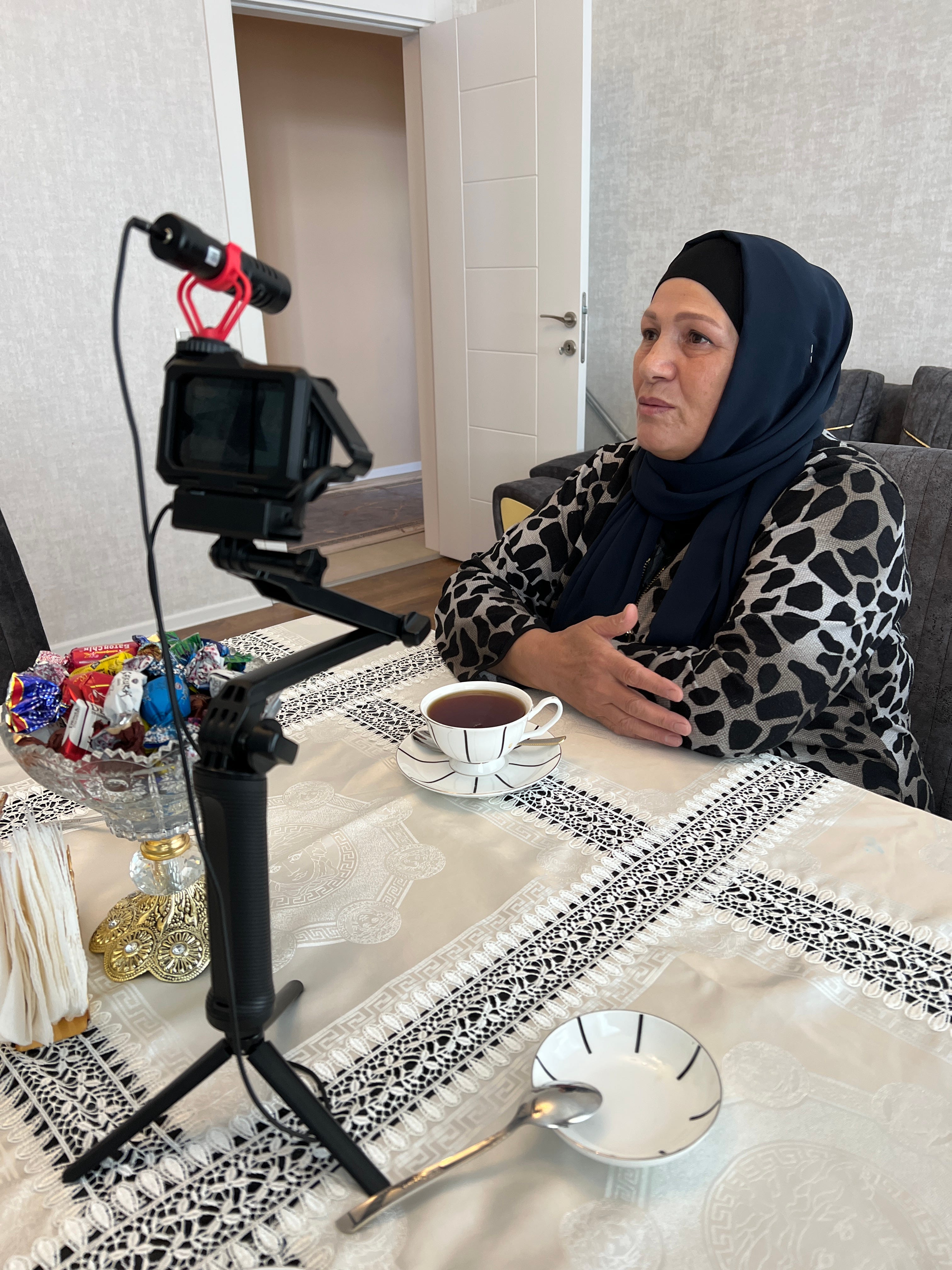
Perhaps the most bizarre encounter was in a recently built public school in İkinci Ağalı, one of the shiny new Potemkin villages built for Azeri settlers after 2020. As I walked through the halls, passing an array of Azeri flags and portraits of the Aliyev family at every turn, I was eventually escorted into a classroom. When I walked through the door, the class of twenty or thirty children rose to their feet in unison. One girl eagerly raised her hand and excitedly asked the young female teacher a question I couldn’t understand but whose answer I already knew. The teacher spastically responded with manufactured enthusiasm and sketched nonsensical diagrams on the whiteboard. Then she turned to me and my handlers and nodded, signifying the performance was over and I could leave.
The entire charade was practiced and rehearsed for God knows how many foreign visitors. No war cemetery, genocide memorial, or ghost town could have hollowed out my stomach more than that performance.
Ganja
By the end, I was all but begging Adnan to head home. I was pulling every excuse out of my hat. I made up some BS that my colleagues needed me to be available for regular calls during the daytime, something impossible in the hinterlands of Nagorno-Karabakh.
The last stop, at Adnan’s insistence, was in the city of Ganja.
Azerbaijan’s second-largest city after Baku, Ganja was the site of significant bombing by Armenian forces in October 2020, killing twenty-six civilians, including six children, and wounding over 140 in a series of rocket attacks. There was no military target in Ganja, and the city itself is about 100 kilometers outside the northern border of Karabakh. The strikes were pure acts of terror against a civilian population.
Adnan made it a point to spend significant time there, touring the ruins of destroyed residential buildings and introducing me to displaced locals who had lost loved ones. In a public park, I met a four-year-old girl named Leyla whose parents and grandmother had been killed by a rocket strike while she was inside the apartment. She was almost two at the time.


When we arrived, Leyla was playing with a doll. Her designated chaperone, a local woman, tried gently to engage her, asking about her name, her age, her kindergarten. But Leyla didn’t speak a word, she only wept incessantly.
“We pulled a huge amount of dirt from her mouth when we found her,” the woman said. “Her father, mother, and grandmother died in the attack. She’s the only survivor.”
Her grandfather, a man who told me he had been in Russia at the time of the attack, spoke through tears as he described how Leyla still screams when she sees the photographs of her parents at the nearby memorial site. “She looks for her father and mother when she comes here,” he said. “We talk about their deaths and she starts crying. She doesn’t have siblings. She’s alone.”
“As an Azerbaijani, would you like to say something to the world?” I asked, sometime after.
“I want them to know that we want peace,” he said. “Thanks to the President and Governor, they helped us. Help came from the government. Karabakh was ours. And we want peace.”


Although the testimony was authentic, and the heartbreak genuine, there was an emotional barrier growing between them and me as the same political diatribes and stale historiographical myths were recycled from nearly everyone I was introduced to. One after the next, affected Azeris appeared, as if by coincidence alone, to share their thoughts on camera.
Before leaving Ganja, we “ran into” an elderly IDP (internally displaced person) originally from Shusha. A retired professor of philosophy and law, he told me he had been a refugee since June 1992 and had changed eleven rental houses in the three decades since. He spoke of Shusha with a tenderness that bordered on the devotional. “Shusha is my seeing eye,” he said. “It’s the centre of culture of Azerbaijan. The music. Hundreds of musicians were there.” He then sang a few lines of Mugham, a traditional Azeri musical form.
“I lost thirty years of my life,” he said. “My house. My garden. Everything. Our graves of relatives are scattered in different places. My father’s grave is in Baku. My mother’s in Sumgait. My sister’s in Shaki. My daughter’s—ten years old at the time—in a cemetery near Agdam that the Armenians plowed over with tractors. When I went back, I found only plowed land. I lost my everything.”
He invited us to his home for tea. We had to decline. For once, no one was waiting for us up ahead. Only the long road back to Baku.
“Please tell this,” he said as we left. “I beg you.”
Khojaly
Before dropping me back at my hostel, we attended a 31st anniversary memorial for the victims of the Khojaly massacre, a mass killing of Azeri civilians by Armenian forces during the First Nagorno-Karabakh War in February 1992. I had an opportunity, alongside dozens of Baku locals, to pay my respects and interview a couple of elderly survivors. Human Rights Watch concluded that no fewer than 200 Azeri civilians were killed, with as many as 1,000 potentially murdered.
One survivor spoke slowly into my camera: “My heart is full of words. But I get sensitive. Let other people and countries hear our voice. Show those things, and make awareness about them.”


Leaving
My last hour with Adnan was spent at a café on the top floor of a Baku high-rise. We were the only ones in the entire venue, aside from a single waiter, as we chatted over cappuccinos beside floor-to-ceiling windows overlooking the city. Despite my apprehensions, I thanked him for the tour and for his generosity.
Beside a handful of maligned tweets and a vast archive of GoPro footage, I knew that I would likely never publish anything of legitimate journalistic merit from this trip. All the evidence and testimony I had collected had been carefully selected and filtered through the interests of the regime. Plus, as far as Western onlookers were concerned, I was a bought-and-paid-for agent of the Aliyevs.
Although my relationship with Adnan had grown a bit tense over the course of our discussions on the road, he seemed satisfied with our journey.
He took it for granted that I had come to know the truth as he did: that Azerbaijan is not what the foreign media makes it out to be. That it wants peace. That it is the rightful heir to these sacred mountains and valleys known simply as Karabakh. That its only waters are those found in the dried remnants of blood soaked in its soil. That it is both victim and victor. Progressive, free, and misunderstood. Isn’t it, Liam?
For Adnan, perhaps this vision is true. Perhaps this is the truth of Karabakh, unfiltered by its prefix.
“Would you like another cappuccino?” he asks. I look at my watch and decline.
“Our problem is public relations,” he adds. “You know, if you ever need work, we could always use help in getting through to a Western audience.”
The short car ride to my hostel was spent quietly scrolling through flights back to Georgia. I already had one scheduled for March 4. But it was February 28, and I needed to get out of this country as fast as possible.
Back at the hostel, I rushed to change my flight reservation so I could catch the next one out, eating a $137.58 CAD fee—a mere pittance relative to the state caviar I’d eaten for a week straight.


What Happened Next
Seven months after I left Azerbaijan, in September 2023, Azeri forces launched a short military offensive against Stepanakert. The operation lasted less than twenty-four hours. Within days, the entire Armenian population of Nagorno-Karabakh—over 100,000 people—fled over the border to Armenia, never to return. Ten Armenian civilians lost their lives in the expulsion. The self-proclaimed Republic of Artsakh was formally dissolved. Azerbaijan’s ethnic cleansing campaign, which the “protest” on the Lachin Corridor had been engineered to support, was complete.
The blockade that Adnan insisted did not exist had done its work: it starved and isolated a population into submission, and when submission wasn’t enough, the military finished the job. The “ecocide” bullshit vanished overnight. It was no longer needed.
From the day I left for Lachin, I was uncomfortable and on edge, having suspected I was being monitored and spied on. They wanted me drunk on caviar. They wanted a credible Western mouthpiece for a country that jails its journalists, whitewashes its ethnic cleansing, and wraps authoritarianism in the language of environmentalism and pride.
For the Azeris, Stepanakert was an illegal settlement of breakaway rebels that violated both the constitution and international law. Indeed, the city was located within the borders of the post-Soviet Republic of Azerbaijan, whose borders were arbitrarily drawn in the early 1920s by Stalin and a handful of Bolshevik zealots with little knowledge of Azeri or Armenian internal politics or ethnic distribution. Within the USSR, Nagorno-Karabakh was given autonomous oblast status and thus enjoyed relative peace; however, the fall of the Soviet Union saw pogroms, hostilities, and war break out as both Armenia and Azerbaijan claimed these lands as the ancestral territory of their respective nations.
Here and elsewhere, we are still living through the collapse of the Soviet Union.
The legal question, for what it’s worth, is hardly a question. Karabakh is Azerbaijani territory—every UN member state recognizes it as such, and no serious argument exists for unilateral secession of a sovereign state on the basis of ethnicity without opening doors nobody wants opened. I believe that. The least that can be asked now is that Armenian cultural heritage (i.e., churches, cemeteries, memorials) isn’t further converted or demolished while the world looks to the infinitely more pressing conflicts unfolding elsewhere. To preserve the memory and the truth is the bare minimum.
The issue, however, is neither memory nor truth. It’s what Azerbaijan chose to do with it. They insisted on expulsion and erasure where integration and reconciliation may have been available. The protesters on the Lachin Corridor may have believed they were defending their homeland. The IDP in Ganja truly lost everything. The girl in the park truly weeps. But the regime that orchestrated their grief into a geopolitical instrument does not deserve the benefit of their sincerity.
I know now, as I did then, that I was in over my head. But I was told to speak the truth. Begged to, even. And if I wanted to speak the truth, I needed to leave for Georgia—someplace poorer, bleaker, and even less friendly, but rich in everything I’d been refused.
This is my best attempt to synthesize my experiences in the South Caucasus with a clear conscience. Despite the accusations, no party on either side offered to pay me or do me any favours—although one side tried its damnedest. I showed up in Baku uninvited, unpaid, and alone. I arrived out of a genuine intellectual curiosity to discover the truth about Lachin Road.
Reflecting on my experience, three years in retrospect, has brought me closer to that truth. The best I can do is to honour it. If we try, as we have, to enact justice on the basis of half-truths or untruths, justice is never served. We only create injustice further down the road.
Just two cents from a guy with a GoPro and no suitcase. I get that it’s not me who bears the consequences of this conflict, and my heart breaks for those who ultimately do. Peace forever, and God help this corner of the world.
(Note: I can no longer find any social media belonging to Adnan Hussein—who, as of 2023, had a somewhat sizable political Twitter following. However, in 2024, CNN cited a “local activist” by his name in an article about marine pollution in the Caspian Sea. Perhaps his environmental commitments weren’t a fabrication after all. Wherever he is, I hope he’s well.)